

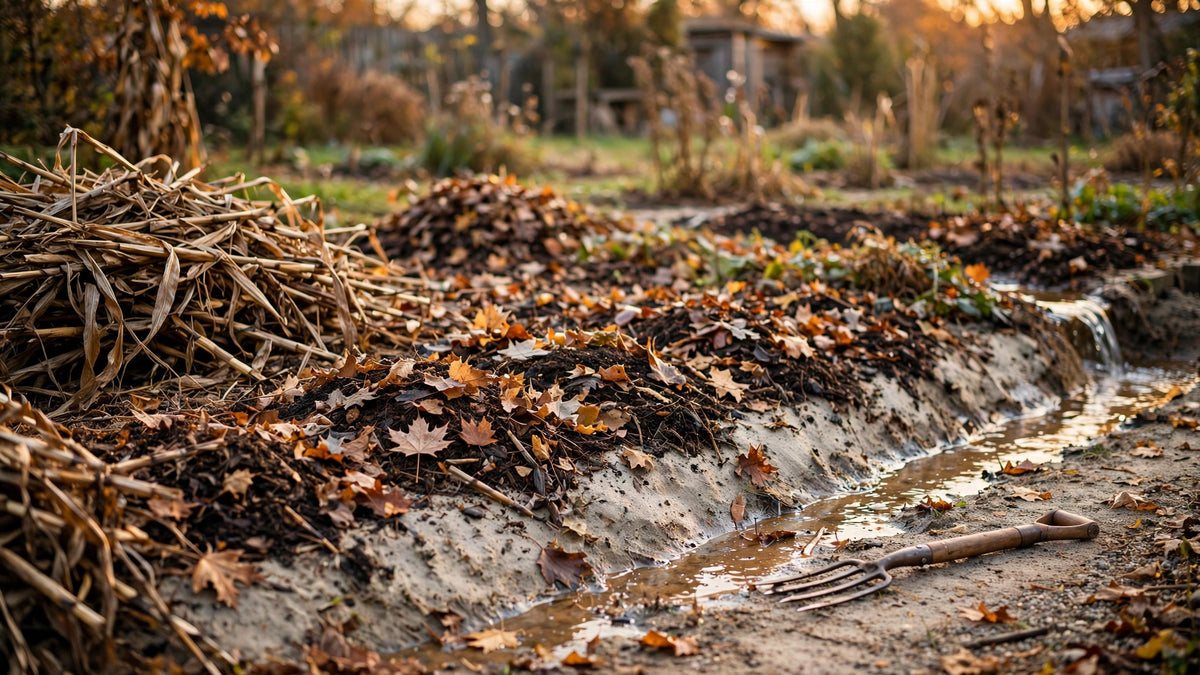
Sandy loam is a sand-rich soil that drains well but can lose water and nutrients quickly when organic matter is low. To improve it without harsh chemicals, start with a soil test and build organic matter with compost. A liquid humic conditioner is an optional helper, not a replacement for compost or fertilizer.
Why does sandy loam lose nutrients so fast?
Sandy loam is a texture class, not a fixed recipe. Supplier guides describe it as roughly 50–70% sand, with smaller amounts of silt and clay (Washington Rock Quarries’ topsoil guide, April 4, 2025; topsoil.com’s soil guide, May 25, 2026). Those ranges are approximations, not a formula for mixing your own soil.
Sandy soils generally hold fewer nutrients and have greater potential for leaching than finer-textured soils, as described by Sharma and colleagues in the 2022 book Insect Pests of Potato, excerpted on ScienceDirect Topics. Water moving below the roots can carry dissolved nutrients with it. Fast drainage is a reason to check moisture and feeding practices, but it cannot tell you how much fertilizer has been lost.
Few places to hold nutrients
Clay and organic matter have charged surfaces that hold nutrients such as potassium. Sand contributes little of that holding capacity. A sandy loam bed low in organic matter therefore needs more attention to nutrient retention than one enriched with compost over several seasons.
Winter rain is the worst window
Leaching risk rises when rain moves through a bed while plants are dormant or absent. In the Southeast and coastal plain, prepare beds before winter and early-spring wet spells rather than waiting until nutrients have washed below the roots. Heavy feeding during dormancy gives plants little chance to use what you apply.
What should a soil test tell you before you buy anything?
Get a soil test through a land-grant university extension lab before buying a conditioner. Request nutrient recommendations and pH, then ask whether the lab offers organic matter and cation exchange capacity testing. Cation exchange capacity measures the soil’s ability to hold positively charged nutrients; it does not directly measure soil structure.
A supplier guide lists a typical sandy loam pH of 6.0–7.0 (topsoil.com, May 25, 2026), but texture does not determine pH. Your bed can fall outside that range. Use its test result, not a typical value, to decide whether it needs a pH adjustment.
Find your soil series first
The mapped soil gives you useful background, though imported topsoil and construction can change what is actually in your yard.
- Enter your address in the USDA Natural Resources Conservation Service Web Soil Survey and select your area of interest.
- Find the mapped soil series and read its drainage description.
- Check the matching county soil survey for more detail about that soil.
- Compare the description with your bed, noting any imported fill when you seek testing advice.
Run the feel test in the bed
This is a quick texture check, not a substitute for laboratory testing.
- Take a handful of moist soil from a few inches below the surface.
- Squeeze it into a ball. Sandy loam usually holds together briefly, then crumbles when poked.
- Press it between thumb and forefinger. It should barely form a ribbon, generally less than 1 inch long.
- If your observations conflict with a laboratory texture result, ask about sampling before drawing conclusions. A routine fertility test may not include texture.
Can liquid humic acid improve sandy loam?
It can help, but results depend on the soil and growing conditions. Humic substances form as organic residues break down. Humic acid can help bind some nutrients and support root-zone processes; it cannot supply the bulk organic matter a depleted bed needs.
What the liquid does in the root zone
A humic conditioner can support nutrient availability and soil biology. Apply it to moist soil at the label rate rather than guessing at a stronger dose. Active growth is a practical time to use it because roots are taking up nutrients.
What it cannot do
A liquid humic amendment does not replace compost or a fertilizer recommended by your soil test. Do not expect it to change soil texture or produce a measurable rise in organic matter within one season. Watch plant growth and moisture between waterings, but remember that weather and irrigation also affect those results.
For GS Plant Foods’ soil amendment, review the Organic Liquid Humic Acid product page and application directions before deciding whether it fits your bed.
How much organic matter does sandy loam need each year?
There is no yearly amount that fits every bed. Use your test results and extension recommendations to choose an amendment rate. Compost and aged manure also add nutrients, so adding more each year without testing can create excesses.
A supplier’s guide describes using compost and manure to improve sandy loam blends (Washington Rock Quarries, April 4, 2025). In an empty vegetable bed, incorporate mature compost into the upper soil as recommended. Around established plants, top-dress without damaging roots, and keep a surface layer of compost or leaf mold to protect bare ground.
Buying more sandy topsoil rarely solves low organic matter by itself. Check what the material contains before paying to bring it in.
A fall and spring schedule for sandy loam beds
Use October as a starting point for beds that will be empty over winter, not a nationwide deadline. In frost-free areas, base feeding on continued plant growth and the rain forecast.
Before the winter rains
Get the test done early enough to act before harvest cleanup.
- Test your bed and map its soil series, then collect samples exactly as the lab instructs.
- After harvest, work mature compost into the bed at the amendment rate your test recommends, not a fixed amount every year.
- Cover any bare soil with compost or leaf mold before the long rains arrive.
- Skip any fertilizer the test does not call for, and avoid applying it before heavy rain or on frozen or saturated ground. Check state and local application restrictions.
When spring growth starts
New growth, rather than a calendar date, is the cue to reassess feeding.
- Use humic conditioner if needed. Apply to moist soil at the label rate.
- Top up the surface cover where it has thinned, and check moisture beneath it before you water.
- Resume feeding only where the crop needs it, following its requirements and your soil-test recommendations.
- Schedule repeat testing at the lab’s recommended interval, sampling at the same time of year each time.
Frequently asked questions
Is sandy loam good for growing vegetables?
Sandy loam is generally a good choice for many vegetables and root crops because its drainage suits them, as described in topsoil.com’s May 25, 2026 supplier guide. Low-organic-matter beds need closer attention to watering and nutrient retention.
Is sandy loam acidic or alkaline?
It can be either; texture alone does not establish pH. Although topsoil.com’s May 25, 2026 guide cites a typical range of 6.0–7.0, test your own soil before adding lime or another pH amendment.
Does humic acid replace compost?
Compost does the job humic acid cannot. It supplies bulk organic matter that helps build water- and nutrient-holding capacity over time. A liquid humic conditioner is an optional addition, not a substitute.
What is cation exchange capacity, and why does it matter on sandy soil?
Cation exchange capacity describes how much positively charged nutrient a soil can hold on exchange sites. Sandy soils low in organic matter generally have fewer of these sites. The measurement helps interpret nutrient-holding capacity, but it does not measure retention of nitrate, which carries a negative charge.
When should I apply humic acid to a garden bed?
Follow the product label and apply to moist soil during active growth. Avoid applications before heavy rain or to frozen or saturated ground. If you need help choosing a GS Plant Foods amendment after testing, use the product inquiry form.


Share:
Organic Biostimulant: What It Does and Whether It Pays in 2026