

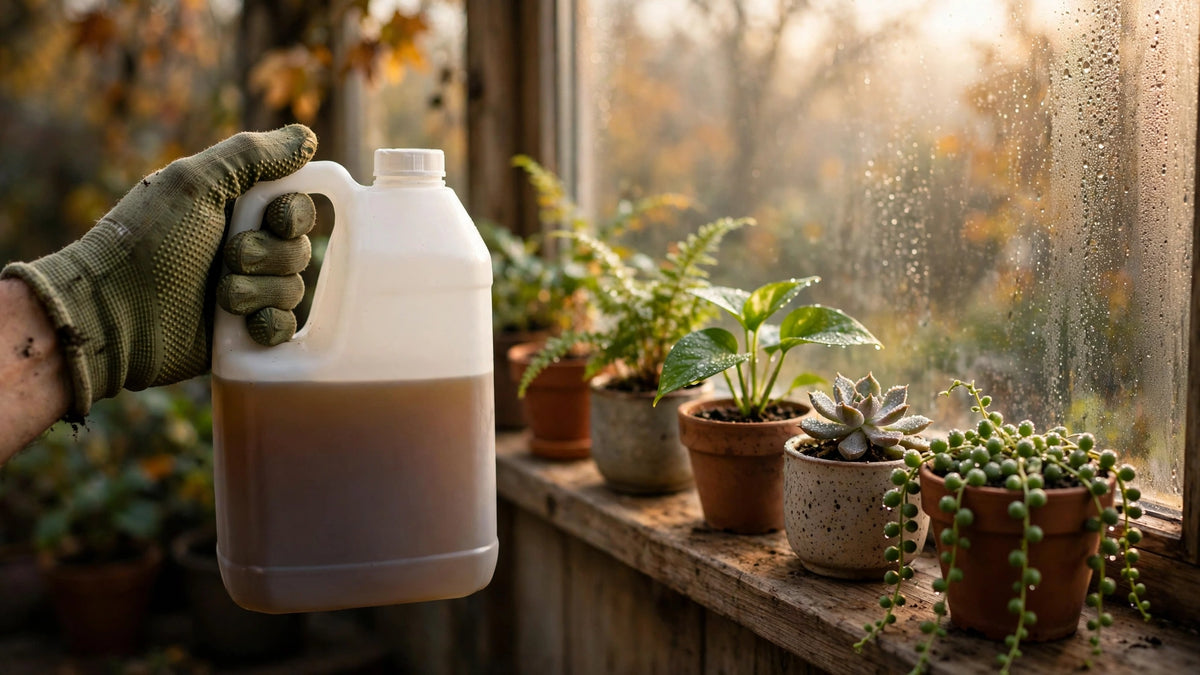
Seaweed fertilizer usually works as a plant biostimulant: it supports root development and stress tolerance rather than supplying a full meal. Liquid seaweed extracts typically test around 0-0-1, so they cannot replace nitrogen when a plant is hungry. Use the label dilution, because a stronger mix can burn roots and leaf margins.
In fall, the right schedule depends on what is still growing. Northern gardens may be winding down while southern gardens have cool-weather vegetables getting established. Indoor plants need a separate decision: if growth slows under shorter days, reduce feeding rather than carrying on with July’s schedule.
What kelp can and cannot do for houseplants
A liquid kelp extract can support roots after repotting or the move indoors, but it is not a complete houseplant fertilizer. Pure kelp contains little nitrogen. Products fortified with added nutrients do a different job, so read the NPK on the bottle rather than assuming every seaweed product is alike.
Yellowing lower leaves can signal nitrogen deficiency, but they can also reflect watering problems or declining light. Check those conditions before adding fertilizer. If nitrogen is lacking, kelp alone will not correct it.
A plant barely growing under winter light needs less fertilizer than one making new leaves in July. Reduce the frequency as growth slows. Repeated feeding that the plant cannot use can lead to salt buildup in the potting mix and burned tips.
Orchids and other sensitive plants
For orchids, use a product whose label names orchids or the intended application, because a general kelp rate may not suit them. Start at the low end of the labeled range and watch the root tips over the following weeks. If tips brown after treatment, stop applying it and check watering and fertilizer concentration before treating again.
Why stronger is not better when you mix kelp
Overdosing is the mistake to avoid. Concentrated kelp can burn root tips and leaf margins, so treat the label rate as a ceiling, not an invitation to add extra.
Many kelp concentrates use about 1 to 3 tablespoons per gallon for a soil drench, but that range is not a substitute for your bottle’s instructions.
If the instructions are unclear, a weak-tea color is a cautious rule of thumb for kelp, not a precise measurement. Concentrates differ in color and strength. Confirm the dilution before using it on sensitive plants or mixing a large tank for a growing operation.
Can you mix kelp and fish fertilizer in one sprayer?
Only mix them if the labels allow it, then jar-test the exact mixture first. Fish fertilizer supplies nitrogen; straight kelp provides little. For a fish product with a stated NPK, see Organic Liquid Fish Fertilizer. Combining the two can serve both feeding and plant-support roles, but that does not mean every formulation will stay mixed in a sprayer.
- Measure a small batch in a clear jar using the same water and product proportions planned for the tank.
- Shake the jar and leave it where you can inspect it.
- Watch it for about 15 minutes. Clumps, unexpected cloudiness or distinct layers are warning signs.
- If solids form or the mixture separates, do not spray it. It can clog nozzles and leave residue on leaves.
- If it stays uniform and both labels permit the application, prepare only what you need. Clean the sprayer after use.
A jar test checks physical compatibility, not plant safety. It does not justify exceeding either label rate. Use the same precaution before combining kelp with an acidic or calcium-rich product. Label any mixing jug with the preparation date, and do not leave a batch sitting for days in a warm garage.
When to use a drench or foliar spray
A soil drench is the default for root support. Dilute according to the label and apply around the base; for a container with drainage holes, water until excess begins to drain. Newly transplanted plants are a useful place to focus kelp applications because root establishment is one of its better-supported roles.
A foliar application can act faster than a drench and may suit a plant under visible stress, provided the product is labeled for leaf application. The general guidance is about half the drench strength, but follow any separate foliar rate on the bottle. Wet the leaves without making them drip.
Spray in the early morning or evening. Strong midday sun dries the solution quickly and increases the risk of leaf injury. Do not use a foliar treatment as a substitute for watering a dry root ball.
| Method | Best for | Rate | Timing |
|---|---|---|---|
| Soil drench | Root establishment after transplanting | Follow the label; many concentrates use 1 to 3 tablespoons per gallon | During active growth, avoiding application to a severely dry root ball |
| Foliar spray | Stress support when leaf application is permitted | Follow the foliar label rate; general guidance is about half drench strength | Early morning or evening, away from strong midday sun |
For our seaweed extract, see Organic Liquid Kelp Seaweed and use the application rate printed on the bottle.
When to stop applying kelp to beds and lawns
A common growing-season interval is every two to four weeks, subject to the product label. Cut back or stop when growth slows in autumn. Follow the plants rather than a nationwide cutoff date: a dormant northern lawn and an actively growing southern vegetable bed do not need the same schedule.
Kelp will not green up a nitrogen-deficient lawn on its own. If nitrogen is the problem, use an appropriate turf fertilizer at the right seasonal rate. Adding more kelp will not make up for the missing nutrient.
What kelp can and cannot do against freezing
Kelp does not make a plant freeze-proof. A tropical plant that cannot tolerate your winter temperatures still needs protection or a move indoors before damaging cold arrives. Stress support is not a replacement for frost protection.
Compounds in kelp, including betaines, are associated with helping plants manage drought stress. That does not establish protection against freezing. Avoid using a late-season kelp application as a reason to delay bringing tender containers inside.
Which plants benefit most and when to restart in spring
Prioritize plants establishing new roots, especially seedlings and recent transplants. For established plants growing well, there may be less reason to add another treatment. The Royal Horticultural Society’s guidance, dated March 12, 2026, notes that most soils already contain adequate micronutrients, so trace-element content alone is not a reason to apply kelp routinely.
Restart when active growth returns, not simply when the calendar says spring. In a home garden or commercial planting, keep kelp alongside the nutrition program rather than counting it as a replacement. Use soil testing to investigate suspected deficiencies before adding more products.
Frequently asked questions
Can I mix liquid fish fertilizer and liquid kelp in the same sprayer?
Yes, if both product labels allow the combination and a jar test shows no physical incompatibility. Test the exact diluted proportions for about 15 minutes; do not spray a mixture that separates or forms solids. A successful jar test does not prove plant safety, so keep both products within their labeled rates.
Can liquid kelp fertilizer burn tender plant roots?
Yes. Overly concentrated kelp can burn root tips and leaf margins. Measure the labeled dilution rather than assuming a stronger solution will work faster; if the directions are unclear, confirm them before treating tender plants.
How often should I apply organic liquid kelp to my garden?
Every two to four weeks during active growth is a common interval, but your product label takes priority. Reduce or stop applications as outdoor growth slows in autumn. Indoors, adjust to actual growth under winter light rather than continuing a summer schedule.
Is liquid kelp fertilizer safe for sensitive indoor houseplants and orchids?
Suitability depends on the formulation, dilution and plant. A general kelp rate may not suit orchids, so choose a product labeled for the intended use and start at the low end of its directions. Stop applications if root tips or leaf margins brown, and check growing conditions before adding more.
Can you make seaweed fertilizer at home?
You can soak seaweed to make a homemade liquid, but its nutrient content and application strength will be uncertain. The Royal Horticultural Society’s March 12, 2026 guidance notes that fresh and dried seaweed are not true fertilizers, because their plant nutrient content is neither guaranteed nor standardized. For measured applications, choose a labeled extract and check its dilution instructions before mixing.
Share:
Potato Leaves Turning Yellow: How to Tell Maturity From Stress