

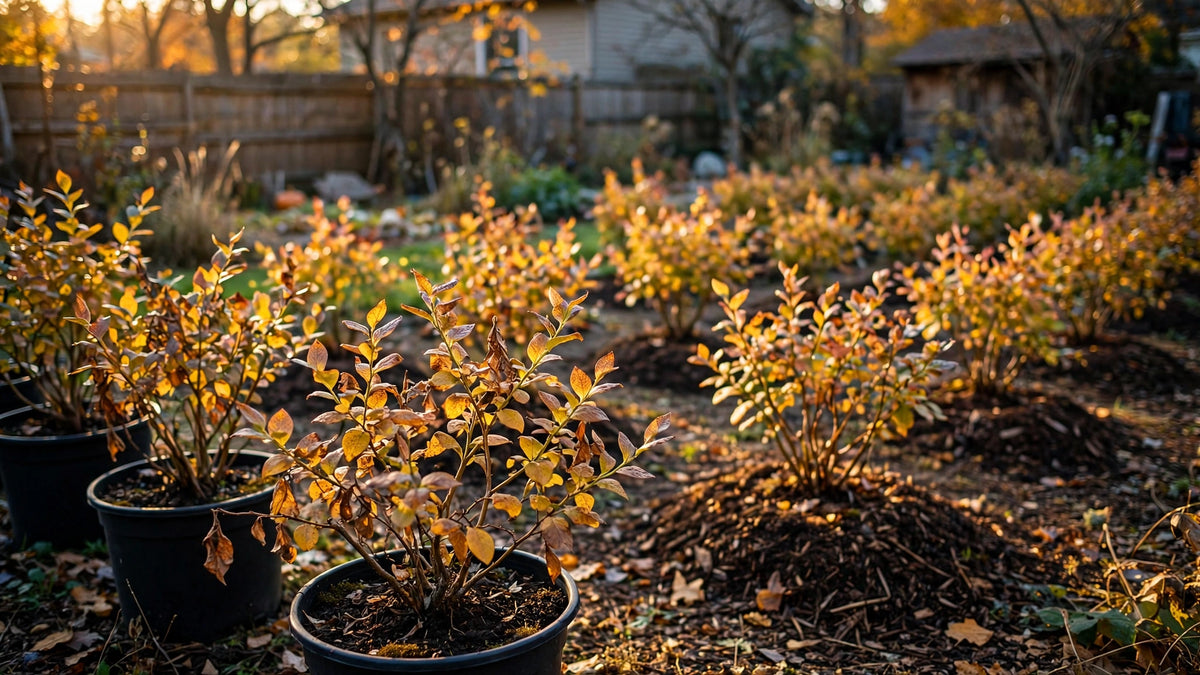
Yellow leaves on a blueberry bush often point to iron chlorosis, especially when young leaves turn pale but their veins stay green. The soil usually contains iron, but a pH above roughly 5.5 can keep roots from absorbing enough. Check soil pH and watering before adding fertilizer.
In November, also check whether the bush is still growing or entering dormancy. A foliar iron spray may help active leaves while you correct the soil. Once leaves begin dropping for winter, stop feeding and prepare for spring.
How Do You Tell Iron Chlorosis From a Nitrogen Shortage?
Start with the youngest leaves at the branch tips. Green veins against yellow tissue suggest iron chlorosis. Older leaves that pale evenly suggest a nitrogen shortage.
These patterns are clues, not a diagnosis. Wet or damaged roots can interfere with several nutrients at once.
| What you see | Points toward iron chlorosis | Points toward nitrogen shortage |
|---|---|---|
| Which leaves | Youngest leaves first | Oldest leaves first |
| Veins | Stay green while surrounding tissue pales | Usually pale with the rest of the leaf |
| Pattern | Yellowing between veins | More uniform paling |
| Soil reading | pH above about 5.5 supports this explanation | A suitable pH does not rule out a nutrient shortage |
For a potted bush watered regularly with hard tap water, put a pH check near the top of your list.
Why Does a High pH Keep Iron Out of a Blueberry?
Blueberries generally need soil between pH 4.5 and 5.5, with 4.8 to 5.2 often given as ideal. As pH rises above that range, iron becomes less available to the roots. Adding more nutrients may leave the underlying problem untouched.
A reading above about 5.5 is the point to investigate pH-related chlorosis first. It is not proof that pH is the only problem, so check drainage before treating the soil.
Why Do Potted Blueberries Turn Yellow Again Every Year?
Repeated watering with alkaline tap water can gradually raise the pH of a container mix. A correction that worked last spring may not hold through another growing season if the water keeps adding alkalinity.
Test the mix in spring and autumn. If its pH keeps climbing, have the irrigation water checked for alkalinity and consider a lower-alkalinity source. Water pH alone does not tell you how strongly it will affect the mix.
Check pH Twice a Year
Use a laboratory test before deciding how much acidifier to apply. Oregon State University Extension recommends laboratory testing over home pH kits for acidification decisions because home results may lack the precision needed. Keep both seasonal results so you can see whether the correction holds.
When the Pot Is Too Small
Roots circling tightly inside the pot can leave a bush short of space and nutrients even in a suitable mix. Plan to repot into fresh acidic mix in spring rather than adding more fertilizer. Avoid disturbing the root ball during a cold snap.
Why Does Feeding a Yellow Blueberry Make It Worse?
General-purpose or lawn fertilizer is the wrong first response to unexplained yellowing. Blueberries are sensitive to overfertilizing, and heavy nitrogen in late autumn can encourage soft growth that is vulnerable to frost. It does not solve iron uptake blocked by high pH.
Even an acid-forming fertilizer supplies nutrients along with its acidifying effect. Repeated feeding is not a safe shortcut to a lower pH.
What Can a Foliar Spray Do for Leaves Still Green?
A chelated iron spray labeled for foliar use can temporarily help leaves affected by iron chlorosis. Gardening Know How’s 2017 gardening guide describes it as a short-term treatment that needs repeating as new leaves appear. Follow the product label; spraying a bush that is already shedding its leaves offers little benefit.
Kelp has a different role. Our Organic Liquid Kelp supports overall plant vitality and stress tolerance, but it is not a substitute for iron treatment or soil pH correction. Use the product’s application directions rather than assuming all foliar products mix at the same rate.
How Do You Correct the Root Zone Without Overshooting?
Elemental sulfur lowers pH gradually. The amount needed depends on starting pH, soil texture and the area treated, so use laboratory recommendations rather than a blanket rate. In cold soil, expect a slow response, not a correction before the next frost.
Do not repeat heavy applications because the leaves have not changed color. Soil correction takes time, and leaf color alone cannot tell you when to add more sulfur.
Our Organic Liquid Humic Acid is a soil conditioner intended to support nutrient uptake and root-zone health. It does not replace a lab-guided acidification plan.
Get a Lab Reading Before You Buy
Ask the laboratory for blueberry-specific recommendations, not just a pH number. Tell it whether the sample comes from an in-ground bed or container mix. The pH reading identifies a possible problem; the full recommendation guides treatment.
What to Keep Off the Shelf
Leave aluminum sulfate out of the blueberry bed, and do not use repeated high-nitrogen feeding to acidify it. Pine-needle mulch is useful for conserving moisture, but University of New Hampshire Extension explains that it does not appreciably lower soil pH.
What Is Still Worth Doing in November, by Climate?
Use local frost timing and the bush’s condition, not the calendar alone. Across much of the North and Midwest, November means preparing for dormancy: collect a soil sample before the ground freezes, check drainage and stop pushing new growth.
In milder regions, leaves may still be active. A labeled foliar iron treatment can offer temporary help for chlorosis, and soil correction can begin while conditions allow. Stop feeding when the bush starts its seasonal leaf drop.
Liquid formulas can be damaged by freezing in transit. Cold-state growers may prefer to plan spring purchases rather than winter deliveries; ask our team through the contact page about ordering timing for your area.
How Do You Winterize Blueberries Before Hard Cold?
Shallow blueberry roots need steady moisture without standing water. Check the soil before freezing weather and water if it is dry. Keep mulch back from the crown so it does not hold moisture against the stems.
Do not try to feed a dormant bush back to green.
Seasonal leaf loss needs no fertilizer. Routine pruning can wait until the plant is fully dormant, which for most in-ground bushes means late winter.
In-Ground Bushes
Water deeply before the ground freezes if the bed needs moisture, then keep checking during dry, unfrozen periods. A loose organic mulch helps protect shallow roots. Avoid piling it against the stems or covering a drainage problem with a thicker layer.
Potted Bushes
Container roots are more exposed to cold than roots in the ground. Move pots to a sheltered location or insulate them before hard cold arrives, especially where temperatures approach the variety’s hardiness limits. Keep drainage holes open and check moisture during winter sheltering.
When Should You Stop Guessing and Get a Diagnosis?
Record four things before buying a treatment: which leaves yellow first, whether their veins stay green, the laboratory pH result, and your watering routine.
If stems begin dying back or unexpected leaf loss continues after you address pH and watering, ask your local extension office how to submit a sample. Root disease and nutrient problems can look similar. If you need help choosing among our plant foods after diagnosis, send those results to GS Plant Foods so the product choice follows the problem.
Frequently asked questions
Should I water blueberry bushes every day?
Not on a fixed schedule. Check the root zone and water when it starts drying, keeping it moist rather than soaked. Containers may need daily attention in hot weather, but cool November conditions usually reduce water demand.
How do I get acidic soil for blueberry bushes?
Start with a laboratory soil test and request recommendations for blueberries. Apply elemental sulfur only at the recommended rate and allow time for it to work. For containers, use an acidic growing mix and check irrigation-water alkalinity if pH repeatedly rises.
What does Epsom salt do for blueberries?
Epsom salt supplies magnesium; it does not correct high soil pH or iron chlorosis. Use it only when testing identifies a magnesium need. Yellow leaves alone are not enough reason to add it.
What month do you cut back blueberry bushes?
Main pruning is usually done in late winter while the bush is dormant, before spring growth begins. The month depends on your climate and blueberry type. Do not cut a bush back simply because its leaves turn yellow in autumn.

Share:
Corn Fertilizer After Harvest: What Stover Breakdown Needs