

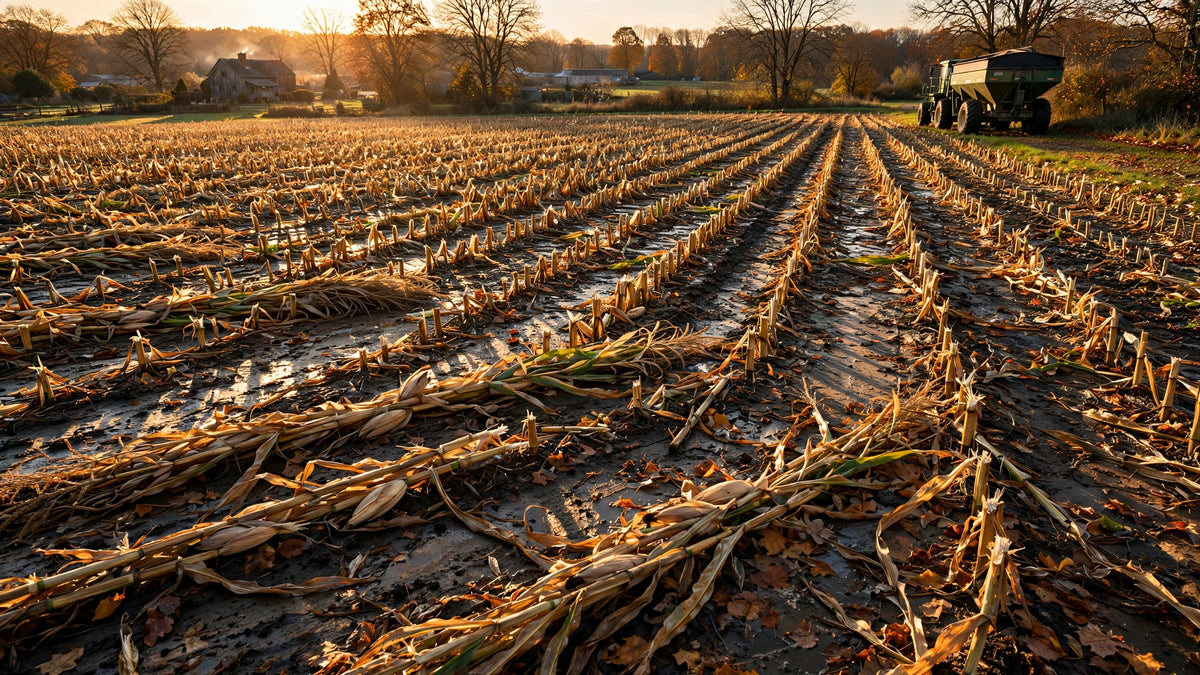
Choose corn fertilizer from your soil test and crop needs, not from the amount of stalks left after harvest. Heavy stover can temporarily tie up nitrogen as it decomposes. Biology and humic acid may support that process, but they cannot replace residue management or a spring nitrogen plan.
For a commercial corn field, start by checking whether the residue will interfere with planting. Then decide whether a fall input has enough time to work and whether its cost makes sense.
1. Walk the field before you price any input
Check how much stover is on the ground and how it lies. Walk the field rather than judging it from the combine cab. Heavy, flattened residue in a cold, wet field decomposes slowly regardless of what you spray.
Include low areas and places where residue has collected. Note whether the stalks are standing or matted down. A fertilizer invoice cannot tell you whether the planter will move through that material cleanly next spring.
2. Rule out the usual causes before blaming the hybrid
Cold soil and dry surface residue slow decomposition. Dense stalk rind and lignin also take time to break down. Check those conditions before attributing slow breakdown to the hybrid itself.
Corn stalks are high in carbon and low in nitrogen, so decomposition takes months rather than weeks. Buying a different input will not overcome frozen soil or make tough stalk material disappear before planting.
3. Plan spring nitrogen around the carbon-to-nitrogen ratio
Stover's carbon-to-nitrogen ratio is wide, so microbes breaking it down can temporarily tie up soil nitrogen. Heavy residue therefore needs a place in your spring nitrogen discussion, even when the field looks ready in November.
Ask your agronomist or extension office before changing fall nitrogen applications. Soil conditions and rainfall affect loss risk, and local recommendations should guide the rate and timing.
For a broad comparison, the USDA Economic Research Service tracks corn fertilizer application rates per fertilized acre by surveyed state (USDA ERS fertilizer use and price data, updated November 13, 2025). State averages are benchmarks, not recommendations for your field. They do not establish a nutrient credit for stover.
4. Check soil temperature and the forecast before you load the tank
Biological activity slows sharply as soil cools in late fall. Once the ground freezes, residue decomposition effectively stops until spring. A product that supports decomposition in warm soil may offer little benefit when applied just before freezing.
Check the label for application conditions and any soil-temperature guidance. Use local extension advice to judge the remaining application window, and check the forecast again before spraying. A calendar date alone cannot tell you whether the soil is warm enough.
Do not pay for a biological pass on frozen ground expecting it to clear residue before planting.
5. What liquid biology and humic acid can and cannot do
Liquid biology and humic acid can support the organisms involved in decomposition. They do not chop stalks, redistribute a residue mat or perform the physical work of tillage.
Our Organic Liquid Humic Acid is a soil amendment intended to support nutrient uptake and root-zone health. Treat it as one part of a soil management program, not as a guaranteed way to remove corn residue. Follow the label for application rates and timing.
If you test a biological input, write down what you expect it to change. Less residue at planting is a different goal from improved nutrient uptake, and each needs its own field check.
6. What fertility comes back, and what the spray pass really costs
Stover contains nutrients, but they do not all become available at once. Potassium can release relatively quickly because it is water soluble. Nitrogen and phosphorus release more slowly as the residue decomposes.
Separate that nutrient value from the cost of managing the stalks. Farm diesel prices rose 46% from late February 2026, according to the American Farm Bureau Federation's April 2026 survey, so get a current fuel figure before you fill in the table. Compare the full operating cost of a spray pass with the tillage pass it might replace, then allow for the possibility that you will still need mechanical residue management.
| Cost item | Tillage pass | Spray pass | What to check |
|---|---|---|---|
| Fuel | Tractor hours and fuel use | Sprayer fuel use and travel | Current diesel price and your usage records |
| Labor | Operator hours | Operator hours, including mixing | Time required for the whole operation |
| Equipment wear | Wear on tillage tools | Wear on sprayer and pump | Your repair and maintenance records |
| Product | No liquid input for this comparison | Liquid input at label rate | Product cost per acre |
| Failure cost | Additional work if residue remains a problem | Additional work if residue remains a problem | Cost of a corrective spring pass or planting delay |
Fertilizer credit from stover
Use your state extension's stover nutrient tables before assigning a fertilizer credit. Review that estimate alongside your soil test and field conditions. Total nutrients in the stalks are not the same as nutrients available to the next crop.
Counting the spray pass against the tillage pass
Fill in the table with your own costs. If the spray leaves you needing the same tillage pass in spring, it has added an expense rather than replaced one. Test that assumption on limited acreage before budgeting a whole-farm saving.
7. Test it on a check strip, then read the planter in spring
Leave an untreated check strip beside the treated area so you can compare residue under similar field conditions. Mark it clearly and manage both areas alike apart from the treatment being tested.
- Record the product rate and soil conditions on spray day.
- Compare residue cover and stalk condition before planting.
- Watch for residue piling at the row unit in both areas.
- Keep the observations with your cost records for next fall.
A check strip in your own field is more useful than a broad sales claim. If residue still obstructs the planter, the treatment has not solved the planting problem, even if some stalks look softer.
For crop nutrition beyond residue management, review GS Plant Foods' Corn Farm Program with your agronomist and compare it with your soil tests and planned nitrogen schedule.
Frequently asked questions
How long does corn stover take to break down?
Corn stover takes months to break down, not weeks. Tough stalk rind and lignin decompose slowly, especially in cold or dry conditions. Decomposition effectively stops when the ground freezes, so plan for some residue to remain in spring.
Can you spray biological residue products on frozen corn stalks?
Do not expect a biological residue treatment on frozen ground to provide meaningful decomposition before the soil warms. Microbial activity is sharply limited by cold conditions. Follow the product label and ask your extension office whether a useful application window remains.
Does spraying residue replace tillage or fix a planter problem?
A biological spray does not perform the physical work of tillage or move stalks out of the planter's path. It may support decomposition under suitable conditions. Use a check strip to see whether that support reduces residue enough to change your field operations.
Can you take a fertilizer credit for corn stover?
Use your state extension's nutrient tables and field guidance to determine whether a credit is appropriate. Potassium releases quickly because it is water soluble. Nitrogen and phosphorus release more slowly as residue decomposes. Do not deduct the stover's total nutrient content from next season's fertilizer budget.
How much nitrogen should go on corn per acre?
There is no single rate that fits every corn field. Your agronomist or extension office should set the rate from your yield goal and local recommendations, including the effects of heavy residue. USDA ERS state application averages provide context, but they are not a field-specific nitrogen prescription.


Share:
Pothos Fertilizer in Winter: What to Feed and What to Skip