
Don't add gypsum to clay soil unless a soil test shows excess sodium. There is no universal application rate: the amount depends on the sodium level and how deep the problem goes. If sodium isn't the problem, gypsum will do little to improve sticky or compacted clay.
Why does gypsum get recommended for every clay yard?
Gypsum supplies calcium. In sodium-affected soil, that calcium replaces sodium on clay particles, helping dispersed particles form aggregates with space for water and air. Water must then carry the displaced sodium out of the root zone.
That mechanism explains gypsum's reputation as a clay amendment, but it also sets its limit. Where excess sodium isn't causing the poor structure, adding gypsum won't solve it. Clay texture alone is not a reason to buy a bag.
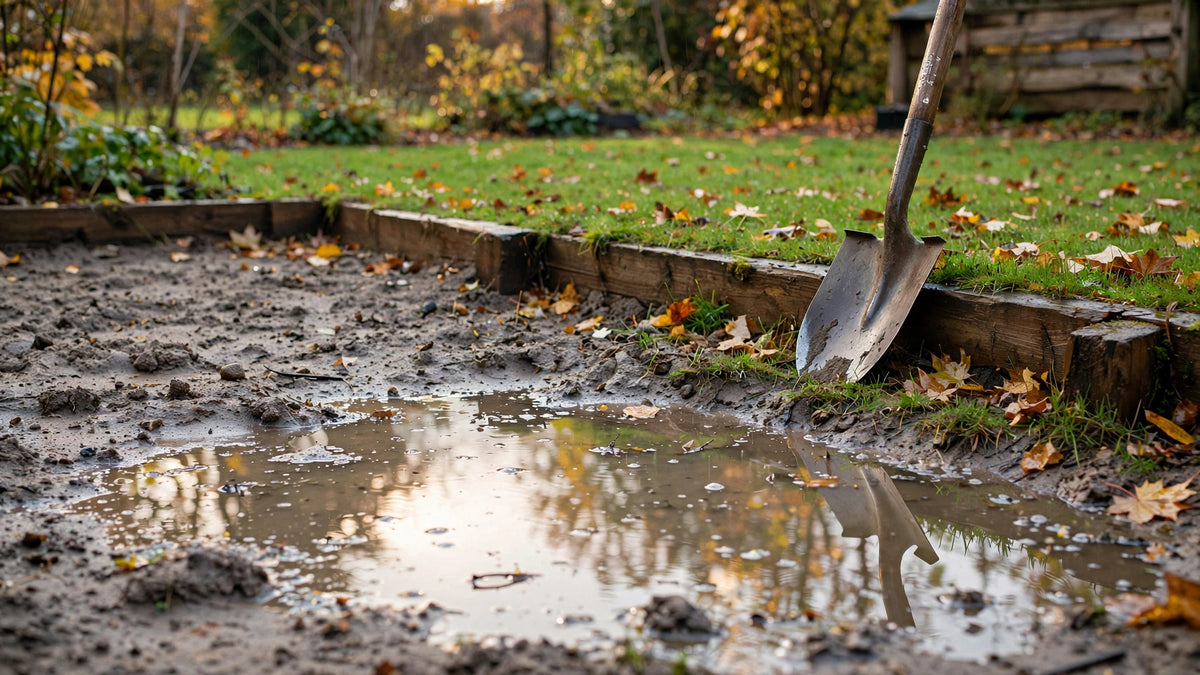
Sticky, waterlogged residential clay usually reflects compaction or low organic matter rather than sodium. Mowing on wet ground can squeeze pore spaces shut. Gypsum does not reopen those spaces the way physical aeration can.
What should a soil test tell you before you buy gypsum?
Ask the lab to check the following, and explain that you're considering gypsum for poorly draining clay:
- pH. This measures acidity or alkalinity. Gypsum is not a treatment for raising soil pH.
- Texture. The proportion of clay helps explain how the soil holds water and how it should be managed.
- Sodium status. Ask about exchangeable sodium percentage (ESP) or sodium adsorption ratio (SAR). These are different measures, so have the lab interpret the appropriate test and recommend a gypsum rate if needed.
A white crust after drying or slick soil that drains slowly when wet is a reason to test, not proof of excess sodium. Compacted clay can crust without a sodium problem. Ask for an amendment recommendation along with the results, rather than trying to turn a sodium reading into a bag count yourself.
How fast does water drain through your clay?
A simple infiltration check helps you judge whether water can move through the soil before you spend money on an amendment:
- Dig a small hole in an area that stays wet.
- Fill it with water and let it drain.
- Refill it and time how long it takes to empty.
As a rough guide, a few hours is workable; several days points to a substantial compaction or drainage problem. This check does not diagnose sodium or replace a soil test. It tells you whether slow water movement needs attention before a treatment that depends on drainage can work.
If sodium is low, what is actually making the clay stick?
Clay's fine particles hold water and pack closely together. Low organic matter and repeated traffic make that structure harder to manage. If the sodium test is low, focus on those problems rather than calculating a gypsum rate.
Keep traffic off wet clay and build organic matter over time. Surface wetting problems may benefit from a surfactant, but a dense layer needs physical attention.
An acidic pH is a separate issue, and gypsum won't correct it.
Fine particles and low organic matter
Compost helps clay develop a more workable crumb structure over several seasons. In garden beds, incorporate it when the soil is moist enough to work without smearing. On established lawns, use surface top-dressing rather than digging through the turf.
Compaction and foot traffic
A hard surface combined with slow infiltration suggests compaction, though it doesn't prove the cause. Redirect repeated foot traffic and avoid working saturated soil. Physical aeration can open channels, but treating only the surface won't remove a deeper compacted layer.
If sodium is high, how much gypsum should you apply?
Use the lab's recommended rate for the area and soil depth being treated. A label rate is a starting point, not a substitute for that calculation. A neighbor's rate can be wrong even when the two yards look alike.
Expect a season or more, not a few weeks.
Gypsum dissolves gradually and needs water moving through the root zone to carry sodium away. If water cannot drain, spreading more gypsum won't solve that obstacle.
Ask the lab when to retest. For a large lawn or farm field, verify the treatment depth and total quantity before ordering heavy bags or bulk material.
Where does a liquid surfactant aerator fit in?
A surfactant aerator, also called a wetting agent, lowers water's surface tension so it can enter water-repellent soil instead of running off. Its role is water entry, not sodium removal.
On dense hardpan, a liquid treatment mainly helps the top inch or two. It does not create pore space through deep compaction the way removing core plugs does. A compacted layer below the surface may still need physical aeration.
Our Soft Soil Liquid Soil Aerator & Lawn Treatment is designed to loosen compacted soil and improve water penetration. Consider it for surface water-entry problems, not as a replacement for correcting poor drainage or a deep hardpan.
What can you use instead of an aerator, and how can you aerate manually?
Hand tools suit small patches where a machine is impractical. Choose the tool by what it does to the soil: a spike makes a hole, while a core tool removes soil and leaves space behind.
Hand fork or spike
A garden fork can loosen small garden patches when the soil is moist but not saturated. Push it in and gently lift to loosen the soil without excessive disturbance around roots. Avoid forcing tools through wet clay, which can smear the sides of the holes.
Rolling spike aerator
A rolling spike tool makes holes through turf without removing plugs. A manual push lawn aerator is an option for surface treatment, but spikes can compress soil around each hole. For substantial compaction, core removal is generally the better choice.
Organic matter over time
Top-dress with compost and allow it to work into the soil over successive seasons. In beds, you can incorporate organic matter directly when conditions are suitable. Neither approach is a weekend cure for deep compaction.
How do gypsum bags and a liquid treatment compare on effort and results?
The cheapest useful treatment is the one that addresses the actual problem. Compare the work involved before buying; prices alone don't tell you whether an amendment will help.
| Option | Effort | Speed | What it does | What it does not do |
|---|---|---|---|---|
| Gypsum on high-sodium clay | Heavy bags and spreading | A season or more | Supplies calcium to replace sodium | Remove sodium without drainage |
| Gypsum on low-sodium clay | Heavy bags and spreading | Little structural benefit expected | Supplies calcium and sulfur | Correct ordinary compaction |
| Liquid surfactant aerator | Mix and apply | Depends on soil conditions | Helps water enter the surface | Fix deep hardpan or grading |
| Manual fork or spike | Labor increases with area | Creates openings during treatment | Opens or loosens the treated surface | Resolve deep compaction across a yard |
| Drainage and grading work | Depends on the site | Depends on the job | Provides a route for water to leave | Change soil texture |
Liquids avoid bag hauling, but they cannot give trapped water an outlet. Check low spots first. Where autumn precedes lawn dormancy, improving water entry then gives roots time to benefit before growth slows. All GS Plant Foods products ship free.
When does clay need more than a bag or a bottle?
Get an on-site drainage assessment when standing water remains for days after storms or flows toward a foundation or slab. High sodium calls for a lab-guided treatment plan, especially over a large area. Neither problem should be handled by guessing how many bags to spread.
Frequently asked questions
Why do people add gypsum to soil?
Gypsum supplies calcium that can replace sodium on clay particles in sodium-affected soil. It can improve structure when excess sodium is the cause, provided water can carry the sodium away. It is not a general treatment for sticky or compacted clay.
How long does gypsum take to break up clay soil?
On sodium-affected clay, expect a season or more. Gypsum dissolves gradually, and displaced sodium must drain out of the root zone. On clay without excess sodium, waiting longer won't make gypsum a compaction remedy.
Is gypsum the same as lime?
No. Gypsum supplies calcium and sulfur without serving as a pH-raising treatment; agricultural lime raises acidic soil pH. Use a soil test to determine which amendment, if either, is needed.
Can I use gypsum and a liquid aerator together?
They address different problems: gypsum treats excess sodium, while a surfactant helps water enter the surface. Use gypsum only at a soil-test-based rate, and follow each product's label rather than assuming they can be mixed. If surface water entry is your concern, look at the Soft Soil product page before choosing a treatment.
Share:
Best Fertilizer for St. Augustine in Fall: What to Use
Best Fertilizer for St. Augustine in Fall: What to Use