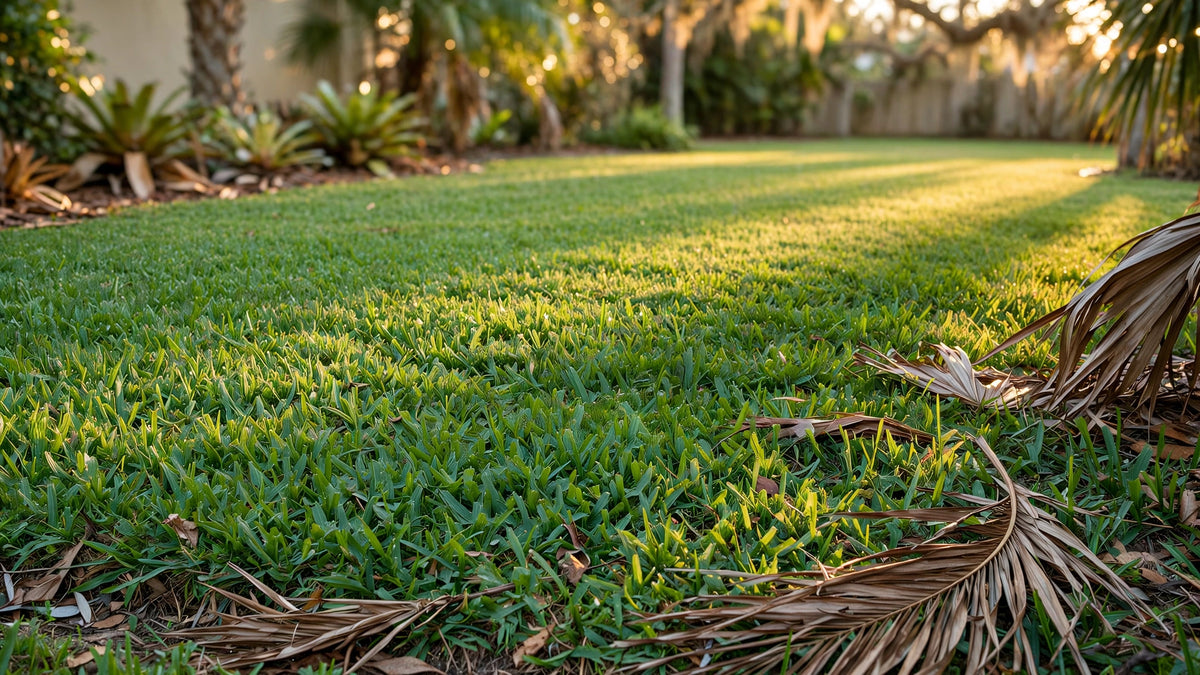
The best fertilizer for St. Augustine in mid-October is iron for color, not a heavy nitrogen feeding as growth slows. Potassium can support winter tolerance where the soil needs it, while kelp supports stress tolerance. The right fertilizer depends on your soil test and climate, not a blanket fall “winterizer” recommendation.
A South Florida lawn still growing in November needs a different schedule from one approaching frost in North Carolina. Before feeding pale fall turf, check watering and mowing, then look for signs of disease.
Why does late nitrogen make St. Augustine vulnerable in October?
Heavy nitrogen feeding produces soft growth and lowers disease resistance. That leaves St. Augustine more vulnerable to fungal damage during weather that favors disease. More nitrogen is a poor trade-off when the lawn is slowing down for winter.
Large patch can appear as circular, dead-looking rings as soil cools in fall. Brown patch produces similar symptoms during warm, wet stretches. Adding fertilizer to those patches will not treat the disease and can make matters worse.
What should you feed St. Augustine instead in mid-October?
Iron improves color without the growth surge nitrogen produces. In Florida, yellow St. Augustine is more often affected by iron deficiency than nitrogen deficiency. A pale lawn is not, by itself, a reason to add nitrogen.
Use the labeled rate on the iron product you choose, and allow the recommended interval before another application. If the color does not improve, investigate the cause instead of increasing the dose. For recommendations based on your grass and seasonal conditions, use our Custom Lawn Program.
When is the last nitrogen feeding before frost?
Finish nitrogen feeding before growth slows for winter, rather than waiting for the first freeze. Clemson Extension advises watching early-autumn weather forecasts because frost dates can vary by several weeks across a state. St. Augustine is the least cold tolerant of the warm-season turfgrasses and turns brown after fall freezes.
Guidance from NC State Extension is to fertilize during active growth and stop by early fall. South Florida is an exception to a fixed autumn cutoff: lawns there may remain active into November. Warm weather alone is not a reason to exceed the annual nitrogen allowance.
UF/IFAS sets the following annual targets for Florida. These are totals for the whole year, not amounts to apply in autumn; divide them among several light feedings.
| Florida region | Annual nitrogen target (lb N per 1,000 sq ft) | What it means in autumn |
|---|---|---|
| North Florida | 2 to 4 | Finish before growth slows as colder weather approaches |
| Central Florida | 2 to 5 | Watch growth and the forecast rather than using a fixed cutoff |
| South Florida | 4 to 6 | Feeding may continue later while grass remains active, within local rules and the annual allowance |
What should you do about rings in the lawn before feeding?
Circular, dead-looking rings suggest disease, not simply a nutrient shortage. Hold off on fertilizer until you know the cause. Large patch and brown patch can look alike, and watering changes may be part of the treatment.
Contact your county extension office or a local turf professional if rings develop, thinning spreads, or the lawn declines suddenly. A diagnosis helps you avoid spending money on fertilizer that cannot fix the problem.
How do potassium and kelp prepare St. Augustine for a mild winter?
Potassium helps St. Augustine tolerate drought and survive winter dormancy. It leaches quickly from sandy Coastal Plain soils, so a soil-test-based program is more useful than assuming one fall dose will last through winter.
Kelp supports plant vitality and stress tolerance, but it does not replace the lawn’s nitrogen or potassium requirements. Our Organic Liquid Kelp Seaweed is an option for that supporting role. Use its labeled schedule rather than adding extra applications ahead of a cold snap.
Liquid feeds can act quickly when absorbed through the leaves. Their effects do not mean nutrients will remain available in sandy soil all winter; the application method and nutrient involved still matter.
How do you apply liquid feed safely on sandy Florida soil?
Sandy coastal soil drains quickly and holds nutrients poorly. A heavy application of fast-release nitrogen can move below the roots, wasting product. During active growth, split light feedings make better use of the annual nitrogen allowance.
Before adding phosphorus, get a soil test. Florida soils are often already adequate in phosphorus, and state rules restrict turf applications unless a test shows a deficiency. Soil testing also guides pH correction: Clemson Extension places St. Augustine’s preferred soil pH at 6 to 6.5.
Check your county’s fertilizer ordinance before setting an application date. Many coastal Florida counties restrict nitrogen during a summer blackout, commonly June through September, but local dates and restrictions vary. For application steps, see our winterizer fertilizer guide. Use the method only when feeding is appropriate for your St. Augustine lawn.
Can Green Envy be applied to St. Augustine and Bermuda?
Green Envy is a liquid turf food designed to green up grass and promote thick growth. Check the current label for permitted turf uses and application rates before applying it to St. Augustine or Bermuda. A product intended to promote growth still needs to fit the season.
The Green Envy Lawn Turf Superfood page provides product details. GS Plant Foods offers free shipping on all products; choose the product and quantity that match your lawn’s needs rather than adding a late-season feeding just for color.
How do water and mowing protect St. Augustine through winter?
Reduce irrigation as growth slows, accounting for rainfall. Water early enough for the leaves to dry before evening, and keep mowing high enough to protect the roots.
- Adjust weekly water to the season. Growing lawns generally need 1 to 1.5 inches per week, including rain. During cool months or dormancy, the guidance drops to about 0.5 to 0.75 inches. Sandy coastal lawns may need that amount divided among more watering sessions.
- Water between roughly 4 and 8 AM. Night watering keeps leaves wet for longer, favoring brown patch and gray leaf spot.
- Keep mowing height at 3 to 4 inches. Cutting below 2.5 inches exposes soil and weakens roots, giving weeds more opportunity.
- Sharpen or replace mower blades every 20 to 25 mowing hours. Dull blades tear the thick leaves, leaving brown tips and openings for disease.
- Return ordinary mowing clippings to the lawn. They decompose quickly and return nitrogen. St. Augustine thatch comes from stolons, not leaf blades.
If you need help matching a product to your fall conditions, use the Custom Lawn Program linked above before ordering another feeding.
Frequently asked questions
Can I fertilize St. Augustine during a county summer blackout?
Do not apply nitrogen during a local nitrogen blackout. Many coastal Florida counties use a June-through-September window, but dates, covered nutrients, and exceptions vary. Check your county’s current ordinance before applying any fertilizer.
What is the difference between brown patch and large patch in St. Augustine?
Both can cause circular, damaged-looking patches. Large patch commonly appears as soil cools in fall, while brown patch is associated with warm, wet conditions. Appearance alone may not identify the problem, so ask your county extension office or a turf professional for a diagnosis before feeding.
Will organic liquid fertilizer burn St. Augustine grass?
Organic fertilizer can damage grass if overapplied; “organic” does not mean burn-proof. Measure the lawn, dilute the product as directed, and follow the labeled application rate. Do not repeat applications sooner than instructed because the lawn still looks pale.
How much water does St. Augustine need in fall in Florida?
Actively growing St. Augustine generally needs 1 to 1.5 inches of water per week, including rainfall. As growth slows in cooler weather, about 0.5 to 0.75 inches is the guideline. Water early in the morning, and reduce irrigation after rain.
Can I use Green Envy on St. Augustine and Bermuda?
Use Green Envy on either grass only if the current product label permits it. Check the turf directions and rate before application. For a fall lawn approaching dormancy, confirm that a growth-promoting feeding is appropriate before buying or applying it.
Share:
How Much Gypsum to Add to Soil? Test Sodium Before You Buy
How Much Gypsum to Add to Soil? Test Sodium Before You Buy