

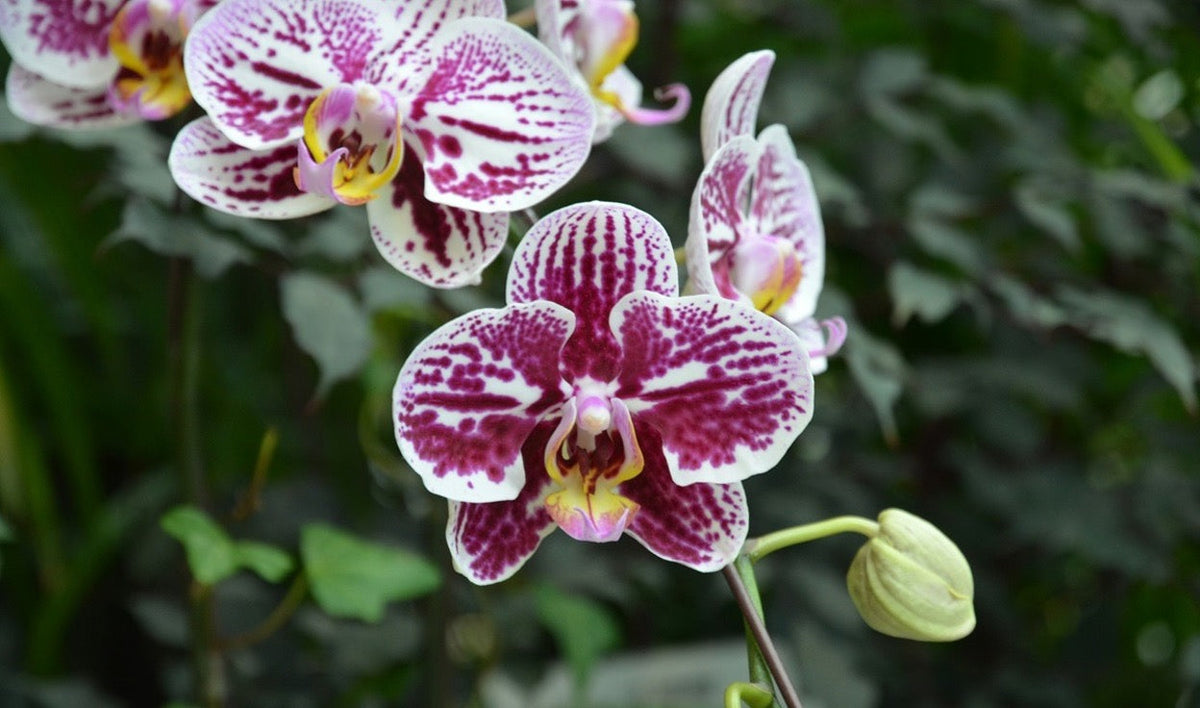
Orchid fertilizer is the single biggest lever most people have over whether their plant reblooms — and it is also the thing most orchid owners get wrong. Orchids are not houseplants in soil. Most of the ones sold in stores are epiphytes: in the wild they grow anchored to tree bark, feeding on a thin, near-constant trickle of dissolved nutrients from rain and leaf litter. Put that plant in a pot of chunky bark and hand it a monthly slug of full-strength plant food, and you are working against its biology.
This guide covers what the numbers on the label actually mean, how much nitrogen, phosphorus and potassium your orchid needs at each stage of its cycle, exact dilution amounts you can measure in a watering can, and how feeding differs between Phalaenopsis, Cattleya and Dendrobium. It also takes an honest look at the “bloom booster” category, because the highest-phosphorus bottle on the shelf is rarely the thing standing between you and a flower spike.
Key Takeaways
- Balanced beats “bloom booster.” A balanced feed plus the right growing conditions outperforms a high-phosphorus formula applied to a plant that is missing its bloom trigger.
- Feed weakly, weekly. Quarter to half strength at most waterings suits orchid roots far better than full strength once a month.
- Bark mixes are nutritionally empty. Unlike potting soil, fresh bark holds almost no nutrients and actively consumes nitrogen as it breaks down, so regular light feeding is not optional.
- Flush monthly with plain water. Dissolved salts concentrate fast in a small pot and will burn root tips and stall blooming.
- Match the calendar to the plant. Phalaenopsis feeds nearly year-round; Cattleyas and nobile-type Dendrobiums need a genuine rest with feeding pulled back or stopped.
- Skip urea-heavy formulas. Urea nitrogen needs soil microbes to become plant-available, and a bark pot has very few of them.
What the Numbers on an Orchid Fertilizer Label Mean
Every fertilizer label carries three numbers — the NPK ratio. They are the percentages by weight of nitrogen (N), phosphorus (P) and potassium (K). A 20-20-20 product is 20% nitrogen, 20% available phosphate and 20% soluble potash; the rest is carrier, micronutrients and, in liquid products, water.
What each one does for an orchid:
- Nitrogen (N) builds leaves, roots and new growths. It is the nutrient bark decomposition steals, and the one most often deficient in a pot that has not been fed.
- Phosphorus (P) supports root development and flower formation. Orchids need it — but they need it in small quantities, and excess phosphorus does not translate into extra flowers.
- Potassium (K) regulates water movement, cell strength and overall stress tolerance. It matters more for bloom quality and longevity than most people realise.
Two label details matter more than the headline numbers. The first is urea. Urea nitrogen has to be converted by microbes before roots can take it up, and a bark or sphagnum mix hosts a fraction of the microbial life that garden soil does. Much of the urea in an orchid pot leaches straight through. Look for nitrogen listed as nitrate or ammoniacal, or for a product that derives its nitrogen from organic sources.
The second is salt index — how harsh the formula is on roots. Orchid roots are covered in velamen, a spongy white tissue that absorbs water and nutrients directly and has no protective barrier against concentrated salts. This is precisely why dilution matters more for orchids than for almost anything else you grow.
Orchid Fertilizer NPK by Growth Stage
The conventional approach rotates three formulas through the year. It is worth understanding, because it is what most of the market sells and what most advice assumes.
| Stage | Conventional NPK | Reasoning | What actually limits you |
|---|---|---|---|
| Active growth (new leaves, new roots) | 30-10-10 “high nitrogen” | Offsets nitrogen tied up by decomposing bark; drives leaf and root mass | Genuinely useful in a fresh bark mix. Less relevant in sphagnum or an older, broken-down mix. |
| Maintenance (most of the year) | 20-20-20 balanced | General-purpose feed, nothing in excess | Fine as a baseline. Nothing about it encourages blooming specifically. |
| Pre-bloom / spike initiation | 10-30-20 “bloom booster” | High phosphorus is marketed as triggering flowers | This is the weak link. Phosphorus is not the bloom trigger for most orchids. |
| In bloom | Balanced, reduced frequency | Sustains the plant while flowers are open | Keep feeding — lightly. Stopping entirely shortens the display. |
| Rest / dormancy | Reduce or stop | The plant is not taking up much of anything | Genus-dependent. Getting this wrong is a common reason for no reblooming. |
The honest version of the bloom-booster story
Bloom initiation in a Phalaenopsis is driven primarily by a drop in night temperature — roughly 55–65°F for two to four weeks — along with adequate light. Not phosphorus. A well-fed plant sitting in a room that never cools at night will keep producing handsome leaves and no spike, no matter which bottle you buy. In Cattleyas and Dendrobiums the trigger is a combination of light, temperature drop and a defined dry rest.
Phosphorus is a genuine requirement, and a plant starved of it will not bloom well. But once that requirement is met, more phosphorus does not buy more flowers — it mostly adds to the salt load in the pot. If your orchid is healthy, well-lit and still not spiking, change its night temperature before you change its fertilizer.
The practical upshot: a consistent balanced or organically-derived feed, applied dilute and often, plus correct light and a night-temperature drop, does more than a shelf of stage-specific formulas.
Bloom vs. Maintenance Feeding Schedules
Two schedules cover most situations. Pick based on what your plant is doing, not what month it is.
| Growth & maintenance schedule | Bloom & post-bloom schedule | |
|---|---|---|
| When to use it | New leaves, new roots or new pseudobulbs are visibly developing — typically spring through late summer | Spike emerging, flowers open, or the plant has just finished flowering |
| Strength | Quarter to half strength | Quarter strength |
| Frequency | Every watering, or three waterings out of four | Every second watering |
| Plain-water flush | Every fourth watering | Every third watering |
| Emphasis | Nitrogen and micronutrients for tissue building | Steady balanced nutrition; avoid pushing new soft growth |
| Winter adjustment | Halve the frequency once growth visibly slows | Phalaenopsis: continue lightly. Cattleya / nobile Dendrobium: stop until spring. |
The signal to watch is new root tips. Bright green, actively extending tips mean the plant is taking up nutrients and you should be feeding. Tips that have gone dull and stopped moving mean uptake has slowed and you should ease off.
The “Weakly, Weekly” Dilution Table
“Weakly, weekly” is the most useful three words in orchid growing: dilute heavily, apply often. It mimics the constant trickle of weak nutrition an epiphyte gets in nature, and it keeps salt concentration in the pot low.
The table below converts the standard label rate for Orchid Love — 1–2 oz per gallon of water — into measurements you can actually make. Full strength here is the top of the label range.
| Water volume | Quarter strength (every watering) |
Half strength (weekly) |
Full label rate (occasional) |
|---|---|---|---|
| 1 gallon (128 oz) | 1 tbsp (0.5 oz) | 2 tbsp (1 oz) | 4 tbsp (2 oz) |
| 1 quart (32 oz) | ¾ tsp | 1½ tsp | 1 tbsp (0.5 oz) |
| 1 pint (16 oz) | ⅜ tsp | ¾ tsp | 1½ tsp |
| 2 gallons | 2 tbsp (1 oz) | 4 tbsp (2 oz) | ½ cup (4 oz) |
Conversions, for reference: 1 oz = 2 tbsp = 6 tsp. A quart is a quarter of a gallon, so any per-gallon rate divides by four for a quart-sized watering can or spray bottle.
How to apply it
- Water first if the mix is bone dry. Nutrient solution applied to a completely dry bark mix runs straight through and can scorch dry root tips. Wet the mix with plain water, wait fifteen minutes, then feed.
- Drench the whole mix. Pour slowly until solution runs freely from the drainage holes. Spot-watering one side leaves half the root mass unfed.
- Never leave the pot standing in runoff. Tip out the saucer. Reabsorbed runoff is concentrated salt.
- Keep solution out of the crown. Water pooling in the centre of a Phalaenopsis is the classic route to crown rot. Blot it out with a paper towel.
- Flush on schedule. Every fourth feeding, water with plain water only — generously, twice through — to carry accumulated salts out of the pot.
Hard tap water complicates this. Water above roughly 200 ppm dissolved solids is already delivering calcium and magnesium, and adds to total salt load. If your water leaves white crust on the pot rim, lean toward the quarter-strength column and flush more often, or switch to rainwater or filtered water for feeding.
Feeding by Orchid Type
Genus matters more than any other variable in this guide, because the rest cycle differs fundamentally between them.
Phalaenopsis (moth orchid)
The orchid in nearly every supermarket. Phalaenopsis have no pseudobulbs and no true dormancy, which means they have no water reserve to fall back on and need steady, uninterrupted feeding. Run the growth schedule at quarter to half strength through spring and summer, then continue at quarter strength roughly every second watering through autumn and winter rather than stopping.
Spikes typically initiate in autumn when night temperatures fall to 55–65°F for two to four weeks. Keep feeding lightly through spike development and flowering — the plant is spending significant reserves and an unfed plant drops flowers early.
Cattleya
Cattleyas store water and nutrients in pseudobulbs and take a real rest. Feed the growth schedule while a new growth is expanding and its pseudobulb is plumping up. Once that pseudobulb has matured and hardened, the plant is done for the cycle: cut feeding back sharply and water less. Cattleyas want high light and generally tolerate a slightly stronger feed than Phalaenopsis during active growth, but pushing fertilizer into a resting plant produces soft growth and no flowers.
Dendrobium
The genus that most rewards knowing what you have. Nobile-type Dendrobiums require a distinct winter rest — cool, bright, much drier, and with fertilizer stopped entirely from late autumn until spikes appear. Feed a nobile through winter and it will reliably produce keikis (plantlets along the cane) instead of flowers. Phalaenopsis-type Dendrobiums, by contrast, rest far less and can be fed lightly year-round. If you are unsure which you have, note when it blooms and how hard its canes go: nobiles drop leaves and flower along bare canes.
Oncidium and Vanda, briefly
Oncidiums follow the Cattleya pattern — feed the new growth, ease off once the pseudobulb matures. Vandas are usually grown bare-root in baskets with no medium at all, which means nothing retains nutrients between feedings; they want dilute feed very frequently, often at every watering year-round, with generous plain-water rinses.
Orchid Love vs. the Generic 20-20-20 Approach
The default recommendation in most orchid literature is a balanced synthetic 20-20-20 at quarter strength. It works. The question worth asking is what it does and does not deliver.
A 20-20-20 powder supplies three macronutrients as soluble mineral salts, and usually a micronutrient package. That is the entire proposition: measured, predictable, cheap, and inert beyond the numbers. Orchid Love takes a different approach — an organic blend of liquid kelp, liquid fish and humic acid with rooting and bloom-supporting agents, formulated specifically for orchids and designed to be used at one dilution across the whole cycle rather than swapped out by stage.
| Generic 20-20-20 | Orchid Love | |
|---|---|---|
| What it supplies | N, P, K as mineral salts, plus micronutrients | Organic kelp, fish and humic acid with rooting and bloom-supporting agents |
| Bio-stimulants | None | Yes — kelp and humic acid components |
| Stage switching | Usually rotated with 30-10-10 and a bloom booster | One formula across growth, bloom and maintenance |
| Dilution | Typically quarter strength for orchids | 1–2 oz per gallon; 1 tbsp per quart for small batches |
| Frequency | Weekly to fortnightly at low strength | Every watering, alternating with plain water every fourth session |
| Nitrogen source | Varies — check for urea | Organically derived |
| Best suited to | Growers comfortable measuring and rotating formulas by stage | Growers who want one bottle, one routine, and a gentler feed for sensitive roots |
Neither is wrong. If you enjoy the precision of stage-specific feeding and you are attentive about flushing, a rotated synthetic programme will grow excellent orchids. If you have killed orchids before by over-feeding, or you simply want a routine you will actually stick to, a single dilute organic feed applied consistently is the more forgiving path — and consistency is what orchids respond to.
Where GS Plant Foods' other formulas fit
| Product | Composition | Rate | Use it for |
|---|---|---|---|
| Orchid Love | Liquid kelp, liquid fish, humic acid, rooting and bloom-supporting agents | 1–2 oz per gallon, every watering | Your everyday orchid feed across the entire cycle |
| Flower Power | Organic fish, kelp and ocean plant extracts | 1–2 oz per gallon, monthly | A monthly addition during spike development and bloom |
| Grower's Honey | 18 L-amino acids, NPK 4-3-3 | 3 oz per gallon, every 1–2 weeks | An amino-acid boost during active growth; a vegan alternative to fish-based feeds |
Five Mistakes That Stop Orchids Blooming
- Feeding full strength on a monthly schedule. This is the most common error and the one that burns roots. Velamen has no defence against concentrated salt. Divide the dose, multiply the frequency.
- Never flushing. Every feed leaves residue behind. Without a monthly plain-water flush, conductivity in the pot climbs until root tips brown off and growth stops — which looks exactly like underfeeding, prompting people to feed more.
- Buying a bloom booster instead of fixing conditions. If light is too low or nights never cool, no NPK ratio will produce a spike. Diagnose conditions first.
- Feeding a resting plant. A Cattleya with a matured pseudobulb or a nobile Dendrobium in winter is not going to use what you give it. The nutrients accumulate as salt, and in nobiles you get keikis instead of flowers.
- Feeding into bone-dry bark. Dry velamen is at its most vulnerable, and dry bark is hydrophobic, so solution channels through without wetting the root mass. Pre-wet, then feed.
How to Choose an Orchid Fertilizer
Work through these in order:
- Check the nitrogen source. Prefer nitrate, ammoniacal or organically derived nitrogen over urea for bark-grown orchids.
- Prefer a liquid if you feed often. Liquids dilute accurately at the small volumes orchid growing involves; powders are easy to under-dissolve and awkward to measure at quarter strength.
- Buy for your routine, not the ideal. A three-bottle stage rotation you abandon in July is worse than one bottle you use every week.
- Read the rate, not just the ratio. A concentrated product at a low rate and a dilute one at a high rate can deliver identical nutrition. The per-gallon rate tells you the real cost per feed.
- Confirm micronutrients are present. Magnesium, calcium and iron deficiencies show up as yellowing and weak growth that no amount of extra NPK will fix.
- Match your water. Hard water already carries calcium and magnesium; soft or filtered water carries nothing and makes a complete micronutrient package more important.
Frequently Asked Questions
What is the best NPK ratio for orchid fertilizer?
For most growers, a balanced ratio such as 20-20-20 at quarter strength, applied consistently, is the best default. A higher-nitrogen 30-10-10 is genuinely useful in a fresh bark mix, where decomposition ties up nitrogen. High-phosphorus bloom boosters are the least important of the three, because phosphorus is not what triggers flowering in most orchids.
How often should I fertilize my orchid?
Weakly, weekly — quarter to half strength at most waterings during active growth, with a plain-water flush every fourth feeding. Reduce to roughly every second watering as growth slows. Stop entirely only for genera that take a true rest, such as Cattleyas after their pseudobulbs mature and nobile-type Dendrobiums in winter.
Can I fertilize an orchid while it is in bloom?
Yes, and you should. Flowering is metabolically expensive. Keep feeding at quarter strength roughly every second watering while flowers are open; a plant that gets nothing during bloom drops its flowers sooner.
Can I use regular houseplant fertilizer on orchids?
You can, at heavily reduced strength — roughly a quarter of the label rate — but check two things. Many general fertilizers rely on urea nitrogen, which performs poorly in bark, and most are formulated for the higher nutrient demand of plants growing in soil. An orchid-specific formula removes the guesswork.
Why won't my orchid rebloom even though I feed it?
Almost always light or temperature rather than nutrition. Phalaenopsis need two to four weeks of night temperatures around 55–65°F to initiate a spike, plus bright indirect light. A plant with healthy green leaves and no spike is usually a well-fed plant in a room that never cools down. For a full walkthrough of the non-fertilizer factors, see our guide to getting orchids to rebloom.
Do organic fertilizers work for orchids?
Yes. The old objection was that organic nutrients need microbial breakdown that bark mixes lack, which is a fair point for raw amendments like meal-based fertilizers. It does not apply to liquid formulations such as kelp and fish hydrolysate, where nutrients are already in solution and immediately available. Their practical advantage for orchids is a gentler salt load, which suits frequent feeding of exposed velamen roots.
How do I know if I am over-fertilizing?
Look at root tips and leaf edges. Blackened or shrivelled root tips, white crust on the pot rim or medium surface, and yellowing or scorched leaf margins all point to salt accumulation. The fix is not to stop feeding permanently — it is to flush the pot thoroughly two or three times with plain water, then resume at a lower strength and higher frequency.
Should I fertilize a newly repotted orchid?
Wait two to three weeks. Repotting inevitably breaks roots, and fertilizer on fresh wounds causes damage. Water normally, wait for new root tips to appear, then start at quarter strength.
Putting It Together
The orchid fertilizer question has a shorter answer than the market implies. Feed dilute and often instead of strong and rarely. Use a balanced or organically derived formula and stop chasing phosphorus. Flush the pot every fourth feeding. Then pay attention to which genus you are growing, because when to stop feeding matters as much as what you feed.
Do those four things consistently and the fertilizer choice becomes the easy part. Orchid Love was the first product GS Plant Foods ever made, built for exactly this routine: one organic formula, gentle enough for velamen roots at every watering, across the whole cycle.
Related Reading
- How to Get Orchids to Rebloom: Care Tips & Best Fertilizers — the light, temperature, spike-trimming and repotting side of reblooming.
- Humic Acid for Plants: Benefits, Dosage & How to Apply
- How to Feed Plants Properly: A Fertilizer Guide
- Preparing Plants for Spring Growth With the Right Fertilizer
Share:
The Complete Guide to Organic Fertilizer for Trees (When, What, and How to Apply)
Best Fertilizer for Root Growth: Nutrients & Application Explained